



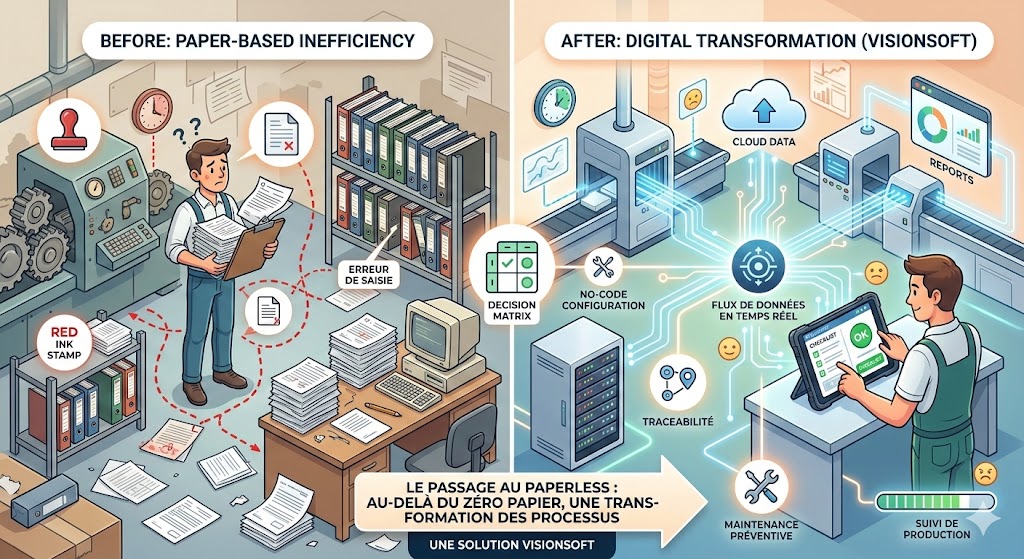
Going paperless in the factory: beyond zero paper, a transformation of processes
Temps de lecture : 3 minutes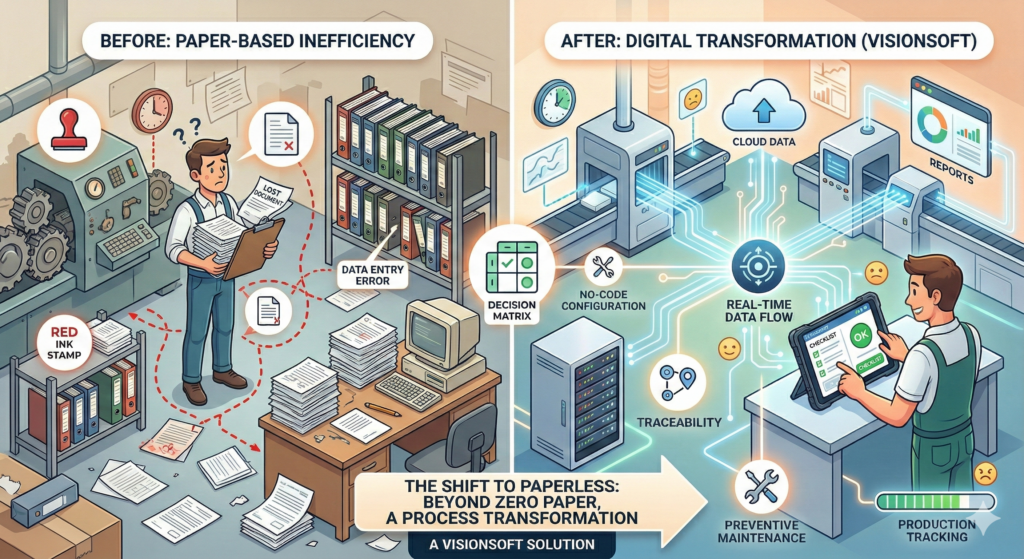
6 Concrete Use Cases for Paperless in the Factory
Here are some projects frequently deployed in industrial environments:
✅ 1. Maintenance Round Management
Digital checklist, photos, anomalies with automatic creation of work orders.
✅ 2. Work Permits and Authorizations
Multi-level validation, automatic authorization control, complete traceability.
✅ 3. Quality Controls
Structured data entry, image integration, alerts in case of non-conformity.
✅ 4. Lockout/Tagout Management
Tracking of steps, cross-validation, complete history of operations.
✅ 5. HSE Audits
Dynamic forms, automatic scoring, instant report generation.
✅ 6. Field Data Collection
Index, consumption, and technical measurements are automatically synchronized.
Common Mistakes in a Paperless Project
Many initiatives fail for simple reasons:
 Scanning PDFs instead of rethinking the process
👉Digitize ≠ transform.
Forget about offline mode
👉A tool that’s unusable 10% of the time is quickly abandoned.
Don’t structure your data
👉Without a solid data model, it’s impossible to use the information effectively.
Neglecting field ergonomics
👉An interface designed for an office doesn’t work on a shop floor.
Paperless as the foundation of industrial AI
The real change appears once field data is structured. At this point, it becomes possible to:
- automatically analyze recurring anomalies
- generate AI-powered intervention reports
- detect quality deviations
- create business agents connected to the data
- produce real-time indicators
Paperless is not an end in itself.
It is the foundation of a data-driven factory.
Conclusion
A successful paperless project is not simply about eliminating paper.
It structures processes, connects systems, and makes data immediately usable.
In an industrial context, this means:
- greater responsiveness
- fewer errors
- greater traceability
- better operational performance
The question is no longer “Should we go paperless?”
The real question is: “How can we do it intelligently?”