


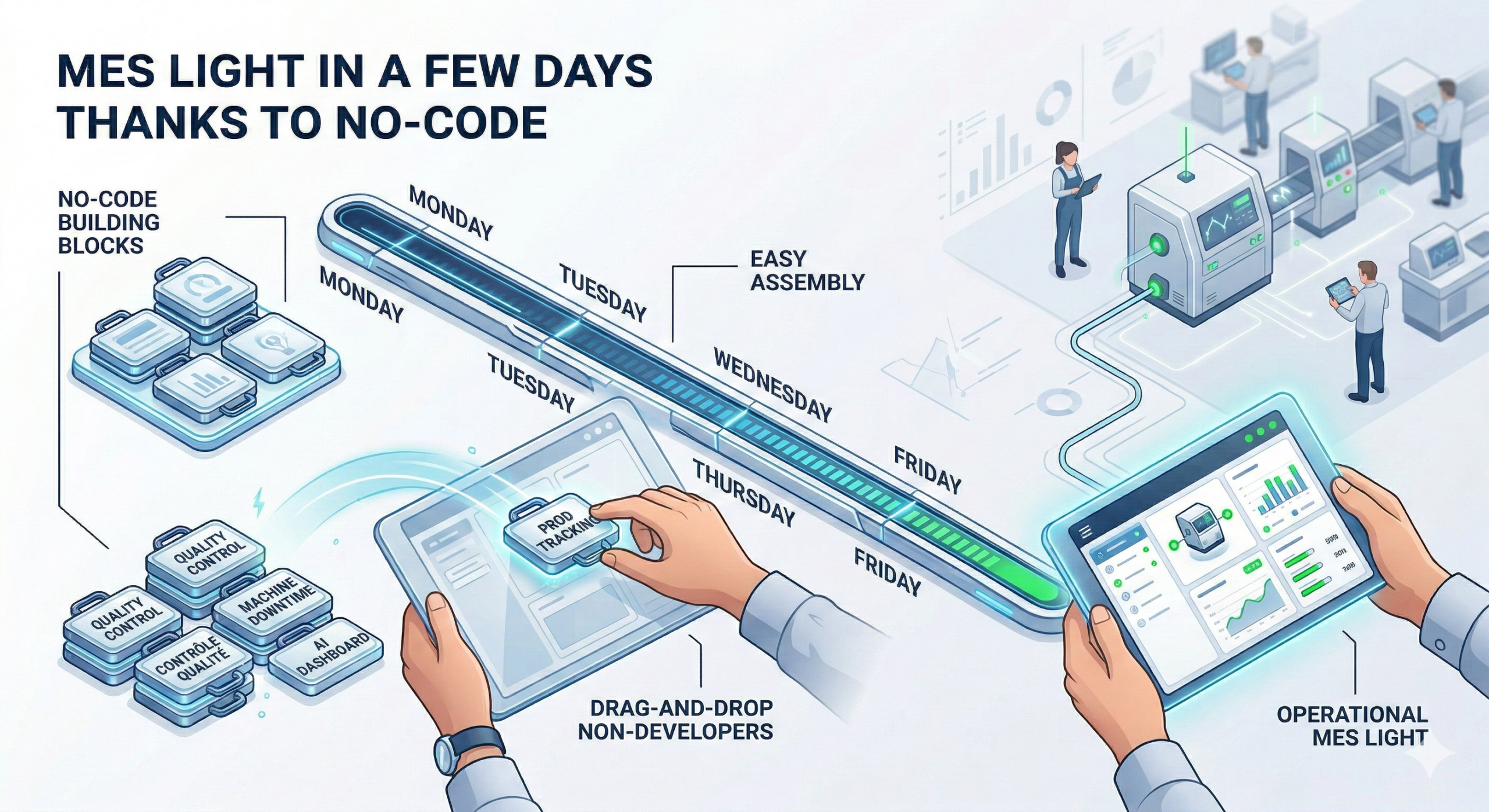
Set up a lightweight MES in just a few days thanks to no-code
Temps de lecture : 3 minutesNot every factory needs a cumbersome, complex, and time-consuming MES.
Many industrial sites are primarily focused on securing their production, monitoring material consumption, and improving operator reliability… without launching an 18-month IT project.
This is precisely the case we will detail here, in the context of the chemical industry, of a need for a simple, operational, and quick-to-implement MES.
Objectives:
👉 Ensure the correct materials are used
👉 Monitor actual consumption
👉 Measure production times
👉 All of this, directly by the operators on the shop floor
And all of this is achieved… with no code.
The Need: Securing Materials in Production
In a chemical environment, a material error is not a simple non-conformity.
It is a quality risk, sometimes a safety risk, and always a high cost.
In this context, it is necessary to:
- Verify that the correct components are used according to the Bill of Materials (BOM)
- Prevent production from starting if the wrong product is scanned
- Accurately monitor theoretical vs. actual consumption
- Provide the operator with a simple, clear, and quick-to-use tool
Not an ERP.
Not an ultra-complex Industry 4.0 MES.
👉 A lightweight, field-oriented MES.
Implementation with Vision MES (no-code)
With VISION, Visionsoft’s no-code platform, the application is built in just a few iterations, directly with the business teams.
Thanks to no-code configured screens and prompts to accelerate certain settings, we can quickly implement the complete shop floor workflow.
1️⃣ Display of material consumption at the start of the shop floor
Before even starting, the operator sees:
- The work order
- The planned materials
- The theoretical quantities from the BOM
👉 They know exactly what they need to use, without having to look up a paper sheet or a PDF.
2️⃣ Mandatory Material Scanning Before Starting
Production cannot begin without verification.
The operator must scan each material (barcode/QR code) before starting.
The system automatically verifies:
- That the scanned material is indeed part of the bill of materials
- That it is the correct part number
- That the batch is valid, if necessary
⛔ Wrong product?
➡️ Immediate alert on screen
➡️ Startup blocked
We move from uncertain human verification to systematic digital security.
3️⃣ Automatic Verification Against the BOM
Behind the operator’s screen, VISION compares in real time:
Scanned Product vs. Expected Product in the Bill of Materials
If there is a discrepancy:
- Clear message for the operator
- Option to alert a supervisor
- Anomaly traceability
Result:
✔️ Fewer material errors
✔️ Less scrap
✔️ Greater compliance
4️⃣ Scan of Actual Consumption at the End of the Workshop
At the end of production, the operator records the actual consumption:
- Scan of containers used
- Automatic entry or retrieval of quantities
- Direct association with the manufacturing order
This results in:
📊 Theoretical vs. Actual
📦 Batch traceability
🧮 History of consumption deviations
All without subsequent administrative re-entry.
5️⃣ Tracking of completion times
Each workshop or production step includes:
- Start time
- End time
- Automatically calculated duration
This data allows us to:
- Measure actual times per operation
- Identify deviations from standard times
- Feed simple and concrete performance indicators
Once again: directly entered by the field, without any complexities.
Why No-Code Changed Everything
It doesn’t start with an 80-page specification document.
It starts with the need: “We want the operator to scan their materials and we want to block the process if it’s not the right one.”
In just a few clicks in VISION Studio and thanks to the Vision MES platform:
- Import products and bills of materials from the ERP
- Customize manufacturing order/operation fields
- Add documentation
- Customize operator screens
- Automatic control rules
- Traceability of scans and times
👉 The business teams saw the tool evolve before their eyes
👉 Adjustments were made live
👉 The MES adapted to the shop floor, not the other way around
A pragmatic MES, focused on the essentials
This type of lightweight MES already delivers significant value:
✅ Securing materials
✅ Reducing human error
✅ Traceability
✅ Consumption tracking
✅ Visibility on production times
✅ Easy adoption by operators
No lengthy project, no heavy custom development, and above all, no constant dependence on IT.
💡The real lesson
You don’t always need a “giant” MES. Let’s not even talk about price…
Sometimes, a few well-thought-out building blocks, quickly constructed with no-code, are enough to transform the reliability of a workshop.
And that’s often how a true Industry 4.0 approach begins:
small, concrete, useful… and used.