


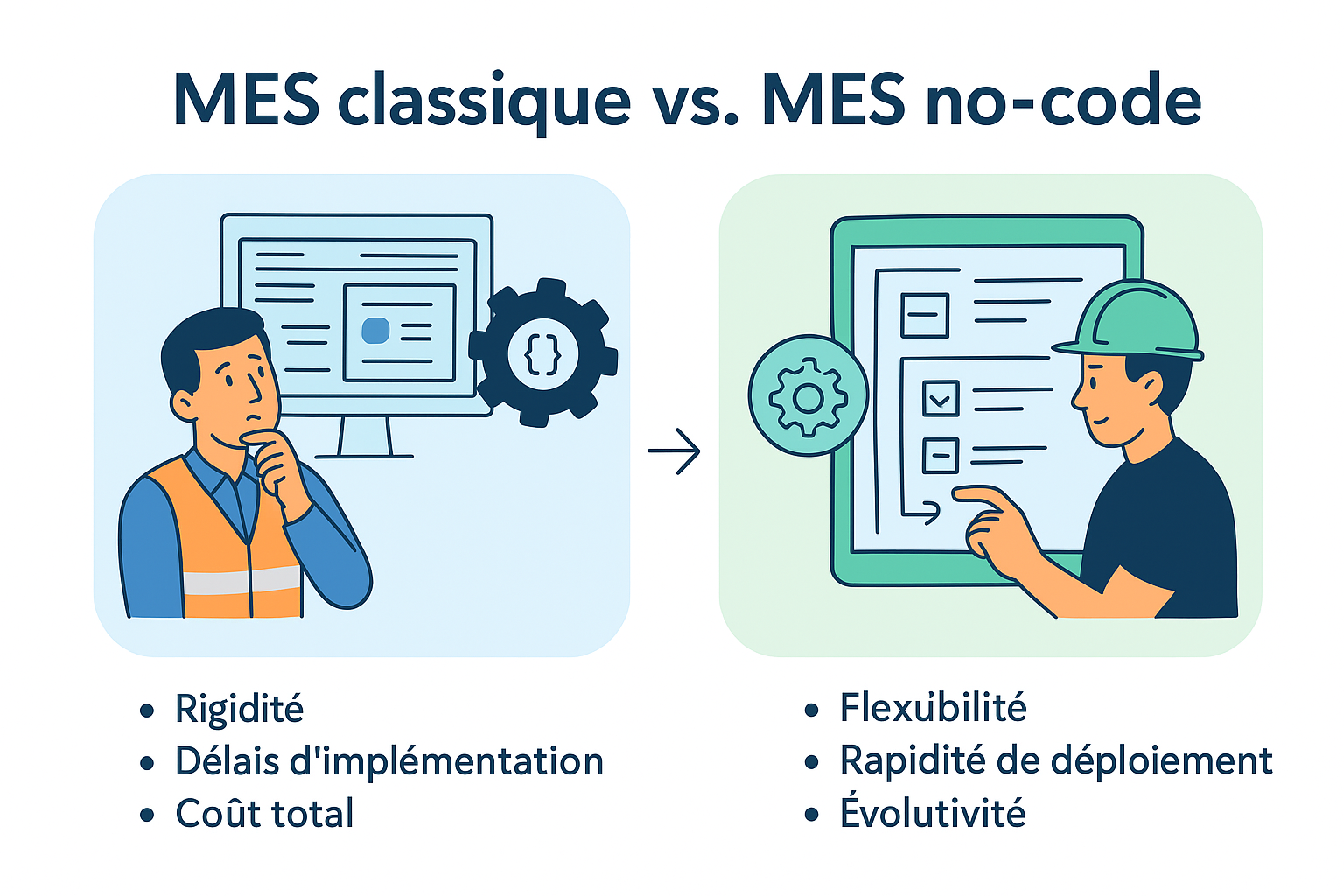
Classic MES vs. No-code MES: Two ways for digitizing
Digitizing production has become a priority for manufacturers who want to stay competitive. But faced with the sheer number of MES options, one question quickly comes up: should you invest in a proven, traditional MES, or opt for a more agile no-code MES? The two approaches don’t address the same realities on the shop floor — and choosing the wrong one can be costly in time, budget, and adoption.
This article compares both perspectives honestly, so you can make the right decision for your context.
What is a traditional MES?
A traditional MES (Manufacturing Execution System) is industrial software designed to manage, track, and control production operations in real time. It bridges the gap between the ERP layer (planning) and the shop-floor layer (machines, operators, production lines).
Typical features of a classic MES
A classic MES generally covers:
- Real-time tracking of manufacturing orders
- Quality and non-conformity management
- Batch and component traceability
- Management of machine and human resources
- Performance indicators (OEE, availability rates)
- Integration with PLCs and SCADA systems
Limitations of a classic MES
Classic MES systems are powerful, but they come with significant limitations for many industrial companies:
- Long deployment time — a classic MES project takes 12 to 24 months on average to become operational.
- High cost — between licenses, integration, training, and maintenance, the budget often exceeds €200,000.
- Strong IT dependence — every change requires an integrator or a developer.
- Functional rigidity — adapting the software to a new process is often a project in its own right.
- Difficult adoption — complex interfaces slow uptake by field teams.
What is a no-code MES?
A no-code MES is a manufacturing execution solution built on a no-code platform — meaning features, forms, dashboards, and workflows are created without writing a single line of code. Operational teams (production managers, shop-floor supervisors, process engineers) can configure and evolve the tool themselves.
What a no-code MES can actually do
- Create field data-entry forms in minutes
- Build custom production-monitoring dashboards
- Automate alerts and workflows without a developer
- Modify an application yourself when the process changes
- Deploy a first version in days, not months
The limitations of a no-code MES
A no-code MES is not a one-size-fits-all solution:
- Less suited to highly standardized environments with strict industry certifications (aerospace, regulated pharmaceuticals).
- Integration with legacy PLCs may require a specific connector.
- Scalability with very high data volumes must be assessed on a case-by-case basis.
Traditional MES vs. no-code MES: a detailed comparison
| Criteria | Traditional MES | No-code MES |
|---|---|---|
| Deployment time | 12 to 24 months | 2 to 8 weeks |
| Initial cost | €100,000 to €500,000+ | €5,000 to €50,000 |
| Required skills | Developers + integrators | Business teams |
| Suited to SMEs / mid-sized companies | Rarely | Yes |
| Suited to large groups | Yes | Depending on the situation |
| Scalability | Slow and costly | Fast and autonomous |
Why manufacturers choose no-code MES
Rapid deployment
In an industrial context where processes change quickly, waiting 18 months to deploy a production-monitoring tool is no longer acceptable. A no-code MES lets you start with a first functional version in a few weeks, test it on a pilot line, and expand it step by step.
Autonomy for business teams
One of the biggest friction points with a traditional MES is the dependence on the IT department or an external integrator. Every form change, every added indicator, every workflow tweak becomes an IT ticket with a waiting time. With a no-code MES, the production manager can:
- Modify a quality-control form
- Add an indicator to the dashboard
- Create an automatic alert when a deviation occurs
This autonomy reduces friction and accelerates continuous improvement.
A much faster return on investment
Digitizing production without a heavy IT project: is it really possible?
The short answer is yes — provided you choose the right no-code platform and clearly define the functional scope from the start.
Key steps to a successful no-code MES deployment
- Identify the priority process — start with the most costly pain points: traceability, quality, maintenance, order tracking.
- Involve shop-floor teams from the start — they will use the tool every day.
- Build a prototype in under a week — validate the concept before scaling.
- Deploy on a pilot line — measure adoption and real gains.
- Iterate quickly — adjust the tool based on shop-floor feedback.
- Scale up site-wide — once the model is validated.
Signs that a no-code MES is right for you
- Your field teams still enter data on paper or in Excel.
- Your IT department is overloaded and can’t prioritize an MES project.
- You need a working solution in less than 3 months.
- Your budget doesn’t allow for a six-figure project.
- Your processes keep evolving and you need flexibility.
What Visionsoft brings to no-code MES
Deploy a no-code MES tailored to the field, in weeks
Visionsoft is a no-code, vibecode-based platform that lets industrial teams build their own business applications without writing a single line of code. Designed for Industry 4.0, it helps you roll out a no-code MES fit to your specific shop-floor needs in just a few weeks.
Among the most common Visionsoft use cases:
- Real-time production monitoring on tablets or shop-floor screens
- Digital quality-control forms with automatic alerts
- Batch and component traceability
- Custom OEE dashboards per line or per shift
- Maintenance-intervention management with full history
Traditional MES or no-code MES: how to choose?
There is no one-size-fits-all answer. The right choice depends on your context, constraints, and objectives.
| Your situation | Recommended solution |
|---|---|
| Large group, strictly regulated environment | Traditional MES |
| SME / mid-sized company needing speed and autonomy | No-code MES |
| Pilot project on a single line before rollout | No-code MES |
| Replacing an existing MES that has reached end of life | Evaluate both |
| Budget < €50,000 | No-code MES |
| Unavailable IT teams | No-code MES |
| Complex SCADA integration with legacy PLCs | Traditional or hybrid MES |
The underlying trend is clear: more and more manufacturers — including mid-sized companies and large-group sites — are adopting no-code approaches to digitize production quickly, without waiting for a major IT project.
Traditional MES remains relevant in very specific contexts. But for the majority of workshops looking to replace paper and Excel with an agile, autonomous solution, no-code MES is now the most fitting answer.

Badr Chentouf
CEO de Visionsoft, Badr Chentouf pilote le développement de la plateforme no-code industrielle VISION et de Vaia, son moteur IA génératif. Entrepreneur passionné par l'innovation, il est engagé dans l'Alliance du LCNC Souverain et intervient régulièrement sur les sujets de transformation digitale, vibe coding et gouvernance applicative en industrie 4.0.